Google Ads vs. Facebook Ads for Small Business
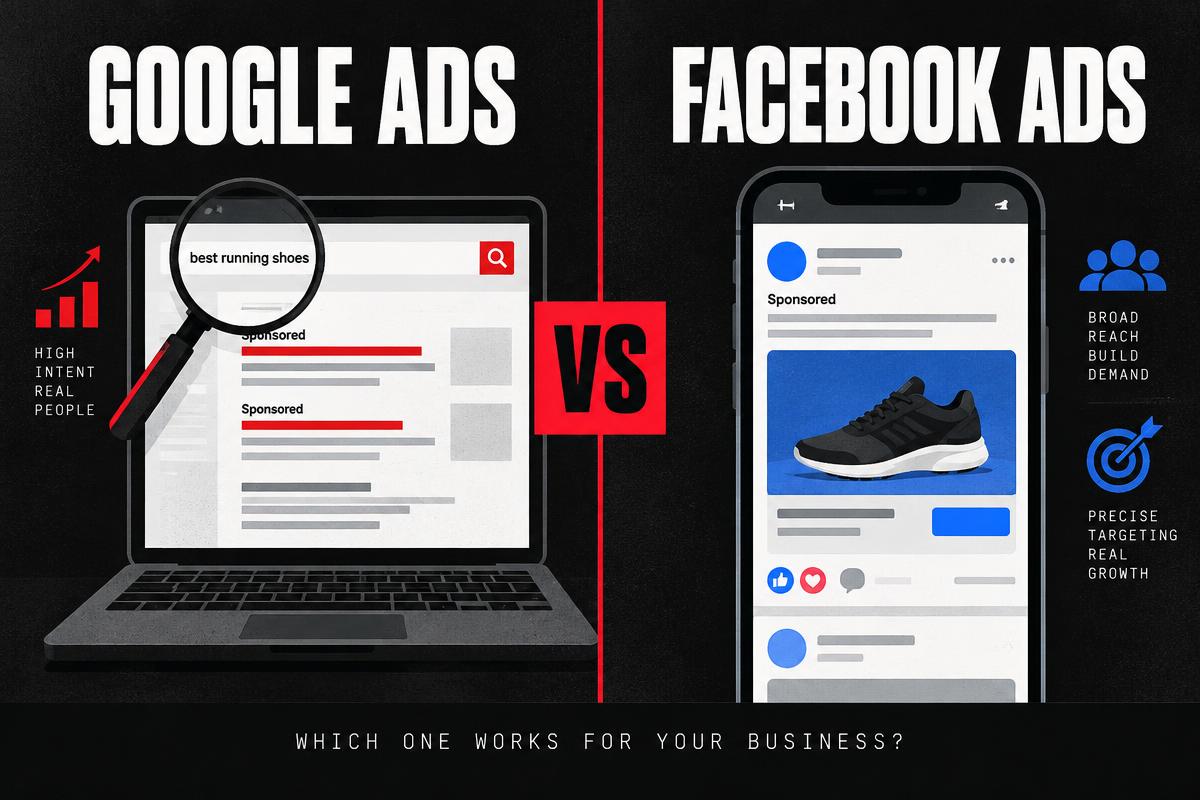
The choice between Google Ads vs Facebook Ads for small business growth depends entirely on how your customers buy. You either capture existing demand or create new interest. If a homeowner has a burst pipe, they search Google for an immediate fix. If a homeowner wants a kitchen remodel, a before-and-after photo on Facebook grabs their attention. Both platforms generate profitable leads, but they require entirely different strategies, budgets, and creative assets.
Understanding the difference between search intent and passive discovery prevents wasted ad spend. Many business owners guess at their targeting. They run a Facebook ad for emergency roof repair and get zero calls, or they pay a premium on Google for broad brand awareness and drain their budget in a week. Here is exactly how to compare both networks, what you can expect to pay for leads, and how to pick the right channel for your specific service.
Evaluating Google Ads vs Facebook Ads for Small Business
The biggest difference between these two networks is the user's mindset. You must align your advertising strategy with what the user is actively doing when they see your ad. If you mismatch the platform and the intent, your campaigns will fail.
Capturing High Intent on Google
Google Ads operate on active intent. The user types a specific problem into the search bar. They want a solution right now. When you run google ads phoenix residents see, you are paying to put your business at the exact top of the search results for those specific keywords.
If someone searches for "commercial HVAC repair near me", they are not browsing for fun. They have a broken air conditioner and a hot building. They are ready to hire a company today. Because the intent is incredibly high, the conversion rate from click to lead is also high. The trade-off is the cost. You pay a premium for this immediate access to buyers.
Generating Demand on Facebook
Facebook Ads operate on passive discovery. Users log in to look at updates from friends or watch videos. They are not actively looking for your product or service. Your ad interrupts their scrolling.
This means you must generate the demand. If you run a landscaping company, a Facebook ad showing a beautifully lit backyard patio can convince a homeowner they need an upgrade. They did not wake up planning to hire a landscaper, but your visual proof created the desire. Facebook excels at building awareness and capturing leads who are in the early stages of the buying cycle.
Creative Requirements for Each Platform
You cannot use the same creative assets across both platforms. What works on a search engine will fail on a social feed. You must build assets specific to the channel you choose.
Google Ads Need Text and Relevance
Success on Google search relies entirely on text and relevance. Your creative work involves writing compelling headlines and descriptions that match the user's search term exactly. If a user searches for "emergency plumber", your headline must say "Emergency Plumber" and state your response time.
Your landing page is the second half of the Google creative requirement. Sending paid search traffic to a generic homepage ruins your conversion rate. You need a dedicated page that matches the exact promise made in the text ad. The page must load fast, display a clear phone number, and offer a simple contact form.
Facebook Ads Need Scroll-Stopping Visuals
Facebook requires strong visual assets. You have less than three seconds to stop a user from scrolling past your ad. When running facebook ads phoenix locals respond to, you need high-quality images, short-form video, and compelling copy.
Video currently dominates Facebook ad performance. A simple video recorded on a smartphone showing your team completing a job or explaining a common problem builds instant trust. You also need distinct offers. A generic "call us today" message falls flat on social media. You need a specific hook, like a seasonal discount, a free inspection, or a buyer guide to get a user to click.
Comparing Lead Quality and Cost
Lead quality and acquisition costs vary wildly between the two platforms. You must calculate your cost per acquired customer, not just your cost per click, to understand if a campaign is profitable.
Google Ads Economics
Google drives the highest lead quality of any digital advertising channel. The leads close faster because the buyer initiated the search. A typical close rate for a Google lead in the home service industry sits between 25% and 40%.
The clicks are expensive. Depending on your industry, a single click can cost anywhere from $5 to $50. If your click costs $20 and your website converts at 10%, you pay $200 for one lead. Because these leads close at a high rate, that $200 acquisition cost is highly profitable for a $5,000 roof repair. You need a monthly budget of at least $1,500 to $3,000 to see consistent, trackable results on Google search.
Facebook Ads Economics
Facebook generates a higher volume of cheaper leads. A lead form campaign on Facebook can generate contact information for $15 to $50 per lead. However, the lead quality is lower.
These prospects are casually interested. They might not be ready to buy for three to six months. Your sales team will need to follow up multiple times. The close rate for Facebook leads typically ranges from 5% to 15%. If you pay $30 per lead and close 10%, your customer acquisition cost is $300. Facebook requires a strong follow-up process, automated text messages, and email nurturing to turn these cheap leads into actual revenue. A starting budget of $1,000 to $2,000 a month provides enough data to optimize a local campaign.
Tracking Conversions and Measuring Success
You cannot measure the success of an advertising campaign by looking at likes, shares, or website traffic. You must track revenue. Both platforms require strict technical setups to track what happens after the click.
Google Ads Tracking Setup
Google requires conversion tracking tags installed on your website. You need to track every time a user fills out a contact form or clicks a phone number. For local businesses, dynamic call tracking is mandatory. A call tracking system swaps the phone number on your website with a tracking number when a visitor arrives from a Google Ad. This records the call, logs the duration, and attributes the lead back to the exact keyword the user searched. If you spend $2,000 a month on ads but do not know which keywords generate paying jobs, you are wasting money.
Facebook Ads Tracking Setup
Facebook relies on a piece of code called the Meta Pixel. This pixel sits on your website and tracks user behavior. Because of privacy changes on mobile devices, you also need to set up the Conversions API. This connects your website server directly to Facebook to ensure no data gets lost. When a user submits a lead form on Facebook, you need automation software to pull that data instantly into your customer relationship management system and notify your sales team. Speed to lead is the most critical metric for Facebook success. If you wait 24 hours to call a Facebook lead, the prospect has already forgotten they filled out your form.
Adjusting Ads for the Phoenix Market
The Phoenix market introduces severe seasonality that changes how both platforms perform. You must adjust your ad spend based on the weather and local demand.
Summer Surges and Search Costs
From May through September, the demand for air conditioning repair, pool maintenance, and pest control skyrockets. During these months, the search volume on Google hits its peak. Competitors aggressively raise their bids to capture this desperate demand. An AC repair click that costs $15 in January will easily cost $45 in July. To survive on Google during the Phoenix summer, you must focus your budget strictly on high-converting keywords and block broad terms that waste money.
Winter Planning and Facebook Demand
When the weather cools down from October to April, homeowners turn their attention to outdoor projects. This is the prime season for landscaping, exterior painting, and patio remodeling. Facebook Ads perform exceptionally well during these months. Homeowners spend more time outdoors and are highly receptive to visual ads showing backyard transformations. You can run Facebook campaigns highlighting winter specials and build a massive pipeline of jobs at a lower cost per lead before the extreme heat returns.
Choosing the Best Advertising Platform for Small Business
Finding the best advertising platform for small business growth comes down to your industry, your budget, and your sales process.
Use Google Ads if:
- You provide an emergency service (plumbing, towing, AC repair).
- Your customers only look for your business when a specific problem arises.
- You have a higher budget and want leads that close within 48 hours.
- You lack the time or resources to create continuous video content.
Use Facebook Ads if:
- Your service is highly visual (landscaping, remodeling, custom auto shops).
- Your product requires education or creates an impulse purchase.
- You want to build brand awareness in a specific local radius.
- You have a dedicated sales team ready to call and nurture leads over several weeks.
Many established companies use both. They use Google Ads to capture immediate buyers and Facebook Ads to retarget the people who visited their website but did not call. This dual approach maximizes your total marketing budget and keeps your brand visible across the entire internet.
Start Growing Your Local Business Today
Guessing at your marketing strategy costs you time and money. You need a structured plan that matches your specific industry to the right advertising channel. Our team builds and manages high-converting campaigns that turn clicks into booked jobs. Contact Phoenix AZ Ad Agency today to schedule a strategy call. We will review your current marketing, analyze your local competitors, and build a custom plan to increase your lead volume this week.
Frequently Asked Questions
Keep readingwebsite design & email · local SEO services · Phoenix website design · all marketing services · book a call