The Dunning–Kruger Effect: Why Every Business Owner Needs to Understand the Danger of Not Knowing What They Don't Know

By Jason Kelly - CEO
The greatest threat to your success may not be your competition, your finances, or even your lack of experience. It may be your inability to recognize what you don't know.
There is a psychological phenomenon that I believe every business owner, entrepreneur, executive, and professional should understand. In fact, I consider it so important that I make a point of introducing it to employees who become part of our organization.
It's called the Dunning–Kruger effect, and understanding it can fundamentally change how you approach business, relationships, professional development, and the people you trust with your future.
At its core, this phenomenon addresses something that I believe is responsible for an extraordinary amount of unnecessary failure in both business and life. People are often unaware of their own unawareness. Think about that for a moment.
What happens when someone doesn't know something, but also lacks the ability to recognize that they don't know it? What happens when that person is responsible for your company's finances, marketing, employees, or strategic decisions? And perhaps the most uncomfortable question of all: What happens when that person is you?
The Bank Robber Who Thought Lemon Juice Made Him Invisible

To understand the Dunning–Kruger effect, we need to go back to 1995 and one of the most remarkable stories in the history of psychological research.
A man named McArthur Wheeler participated in two bank robberies in Pittsburgh, Pennsylvania. What made this particular case so extraordinary wasn't the robberies themselves. It was Wheeler's apparent belief that he had discovered a way to make himself invisible to security cameras.
His solution? Lemon juice.
Wheeler reportedly believed that because lemon juice could be used as invisible ink, applying it to his face would prevent security cameras from recording his image. He proceeded with the robberies without a conventional disguise. Naturally, the cameras recorded him.
When authorities eventually arrested Wheeler, he reportedly expressed disbelief that the police had been able to identify him. The story is often recounted with his astonished declaration:
"But I wore the juice!"
Now, most of us hear that story and immediately recognize the absurdity of the situation. But psychologist David Dunning saw something much more interesting.
What if Wheeler's problem wasn't simply that he was wrong? What if he lacked the knowledge necessary to recognize just how wrong he was? And what if that same underlying problem affected otherwise ordinary people in their professional and personal lives?
That question helped inspire research conducted by David Dunning and Justin Kruger at Cornell University. Their findings would eventually become one of the most widely discussed concepts in modern psychology.
Unskilled and Unaware of It: The Research That Changed Our Understanding of Confidence
In 1999, Justin Kruger and David Dunning published a research paper in the Journal of Personality and Social Psychology titled: "Unskilled and Unaware of It: How Difficulties in Recognizing One's Own Incompetence Lead to Inflated Self-Assessments."
The researchers conducted four studies examining people's actual performance and their ability to assess that performance. They tested participants in areas including logical reasoning, English grammar, and humor. After completing the assessments, participants were asked to estimate how well they had performed relative to others.
What the researchers discovered was fascinating. Participants who performed in the lowest quarter of their respective groups substantially overestimated their abilities. In the original research, participants in this lower-performing group averaged around the 12th percentile in actual performance but estimated their performance around the 62nd percentile.
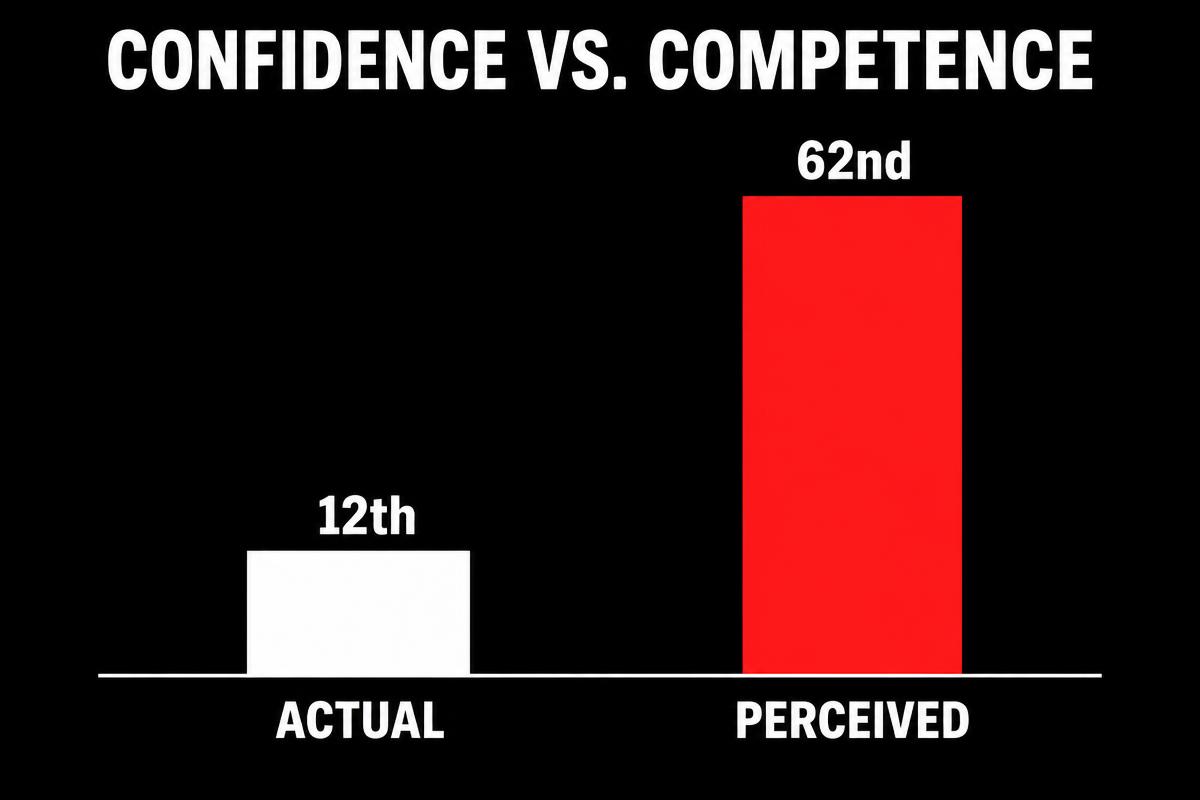
Think about what that means. These individuals were performing worse than approximately 88% of their peers, yet they believed they were performing better than approximately 62% of them. That's an enormous difference between perceived ability and demonstrated ability.
And this is where the research becomes particularly relevant to business owners. The participants weren't necessarily being intentionally dishonest. They weren't necessarily trying to deceive anyone. They simply weren't accurately recognizing their own limitations.
The researchers proposed that the knowledge and skills required to perform a task successfully are often closely related to the knowledge and skills required to recognize whether that task has been performed successfully. In other words, the very thing preventing someone from performing well may also prevent them from recognizing that they're performing poorly.
The researchers also found that higher-performing participants sometimes underestimated their relative standing.
The lesson isn't that everyone who lacks ability is arrogant or that everyone who possesses ability is humble. The lesson is that confidence and competence are two very different things. And confusing the two can become extraordinarily expensive.
Metacognition: One of the Most Powerful Tools in Your Professional Toolbox
There is a word that I believe every business owner should become familiar with. Metacognition.
In simple terms, metacognition is the ability to think about and evaluate your own thinking. It's the ability to step outside your immediate assumptions and ask yourself whether your understanding of a situation is accurate.
It's recognizing that you might be wrong. It's understanding that someone else might know more than you. It's being able to assess your abilities in relation to your peers using evidence rather than ego. And perhaps most importantly, it's having the intellectual discipline to adjust your thinking when confronted with information that challenges what you believe.

Imagine two business owners.
The first has operated a company for 15 years. He believes that because he's been in business for so long, he understands marketing, finance, technology, customer acquisition, and management better than most people. Whenever someone offers a different perspective, he becomes defensive. Whenever a consultant identifies a weakness, he explains why the consultant doesn't understand his business. Whenever an employee proposes an improvement, he dismisses the suggestion because he's been doing things his way for years.
Now imagine a second business owner. She has operated a company for five years. She understands that her experience has given her valuable knowledge, but she also recognizes that there are professionals who have spent their entire careers mastering individual disciplines. She asks questions. She measures results. She welcomes constructive criticism. She evaluates the qualifications of the people offering advice. And when someone demonstrates a better way to accomplish something, she listens.
Which business owner do you believe is better positioned for long-term success?
The difference isn't necessarily intelligence. It isn't necessarily education. And it certainly isn't the number of years they've been in business. It's their relationship with their own limitations.
Your Ego Can Become Your Company's Greatest Liability
One of the most dangerous things that can happen to a business owner is allowing their ego to interfere with their ability to learn. And I've seen this problem manifest itself in countless professional interactions.
Someone enters a conversation believing they are the most knowledgeable person in the room. Then they encounter another person or organization that possesses greater experience, stronger qualifications, better technology, or demonstrably superior results in a particular discipline.
At that moment, they face a decision. They can recognize the opportunity to learn from someone who knows something they don't. Or they can interpret that person's expertise as a threat to their own importance.
Those two responses can send a person down entirely different paths. One creates an opportunity for professional development, stronger partnerships, and improved decision-making. The other creates defensiveness, resentment, missed opportunities, and potentially years of unnecessary struggle.
Being confronted with someone else's expertise is not an attack on your intelligence. It's an opportunity to expand it.
You don't become less capable because someone else knows more about a particular subject. You become more capable when you're willing to learn from them.
Consider the business owner who refuses to hire a qualified accountant because he believes he understands his finances well enough. Or the executive who rejects a more efficient technology because she doesn't understand how it works. Or the entrepreneur who refuses to consider a different advertising strategy despite months of disappointing results.
These decisions can have real financial consequences. And sometimes the obstacle isn't a lack of available information. It's an unwillingness to acknowledge that the information might reveal a personal limitation.
Why Feedback Alone Isn't Always Enough
One of the most interesting elements of the original Dunning–Kruger research involved examining whether people could improve their understanding of their own abilities.
The researchers found that lower-performing participants could struggle to accurately assess their performance even when given opportunities to compare their work with that of others. But there was an important discovery. When participants received training that improved their underlying skills, their ability to recognize their earlier mistakes also improved.
That distinction matters. It suggests that improving self-awareness sometimes requires more than simply telling someone they're wrong. People may need to develop enough knowledge to understand why they're wrong.
This is something I believe every business owner should consider when managing employees, evaluating consultants, or developing their own professional abilities.
You can show someone a report demonstrating that their advertising campaign is underperforming. You can explain that their website isn't converting visitors into customers. You can provide evidence that their sales process is losing qualified prospects. But if they lack the foundational knowledge necessary to interpret that information, they may not immediately recognize its significance.
This doesn't mean people are incapable of learning. Quite the opposite. It means education, practical experience, objective measurement, and constructive feedback are essential.
And that brings us to a particularly important lesson. The purpose of discovering that you're wrong isn't to prove that you're inadequate. It's to give yourself the opportunity to become better.
The Dunning–Kruger Effect and the Business Advice You Receive
Now I want you to consider something that directly affects your organization. Think about the people you're taking advice from.
Think about your marketing agency. Your website developer. Your financial advisor. Your business consultant. Your advertising specialist. Your friends. Your employees. Even the people you follow online who present themselves as authorities on entrepreneurship and success.
How are you determining whether these individuals actually possess the expertise they claim to have? Are you evaluating their work? Are you examining measurable results? Are you asking about their qualifications and experience? Or are you simply accepting their confidence as evidence of competence? Because those are two very different things.
We live in a world where someone can establish an online presence, purchase a professional-looking website, produce a handful of videos, and begin presenting themselves as an expert almost overnight. The barrier to claiming expertise has never been lower.
But claiming expertise and demonstrating expertise are not the same thing. And as a business owner, failing to understand that distinction can cost you an extraordinary amount of money.
Someone who confidently promises to triple your revenue isn't necessarily more qualified than someone who carefully explains what they can realistically accomplish. Someone who describes themselves as the best marketing agency in the industry isn't necessarily more capable than an organization that provides verifiable examples of its work. Someone who speaks with absolute certainty isn't necessarily more knowledgeable than someone who openly acknowledges the limitations of their expertise.
In fact, a willingness to acknowledge uncertainty can be an important sign of professional judgment.
Do They Tell You They're the Best, or Do They Tell You What They Can Deliver?
This is one of the most important distinctions I want business owners to understand.
When evaluating a professional relationship, ask yourself a simple question. Does this person spend more time telling me how great they are, or explaining what they're going to accomplish and how they're going to measure it?
There's nothing inherently wrong with confidence. Successful professionals should have confidence in their abilities, particularly when that confidence is supported by experience and measurable results. But confidence without accountability should never be mistaken for competence.
When evaluating a marketing agency, for example, I would encourage you to ask questions such as:
- What specific services are you going to provide?
- What measurable objectives are we trying to accomplish?
- How will we determine whether your work is successful?
- What experience do you have with businesses like mine?
- What evidence supports your recommendations?
- What limitations or risks should I understand?
- What happens when a strategy doesn't produce the expected results?
- Will you acknowledge when something isn't working and explain how you intend to improve it?
Notice something about those questions. None of them asks whether the agency believes it's the best. Because that isn't what matters.
What matters is whether the organization possesses the competence, integrity, and accountability necessary to do what it promises. And whether it can recognize its own limitations.
The Most Dangerous Business Owner Is the One Who Believes They Have Nothing Left to Learn
There is another side to this conversation that deserves attention. The Dunning–Kruger effect isn't simply a convenient psychological explanation for why other people make poor decisions. It's an opportunity to examine ourselves.
Because every one of us has limitations. Every business owner has areas of expertise and areas of weakness.
You might be an exceptional salesperson but struggle with financial management. You might be a brilliant technician but have difficulty communicating with employees. You might understand your industry better than anyone in your market but know very little about modern advertising technology. You might have built a successful company using methods that worked exceptionally well 15 years ago, without recognizing how dramatically the marketplace has changed.
None of those limitations makes you a bad business owner. But refusing to recognize them can prevent you from becoming a better one.
And this is where I believe the real value of understanding the Dunning–Kruger effect begins. It's not about identifying people who are less knowledgeable than you. It's about developing the discipline to recognize when you are the person who needs to learn.
The moment you become convinced that your success has eliminated the need for additional education, you've created an unnecessary obstacle to your future growth.
Why We Teach This at Phoenix AZ Ad Agency
At Phoenix AZ Ad Agency, I believe professional development begins with self-awareness. That's why I make a point of introducing employees to the Dunning–Kruger effect and the importance of metacognition.
I want the people who become part of our organization to understand that encountering someone who possesses greater knowledge or stronger abilities in a particular field is not something to fear. It's something to appreciate.
I want them to understand that being corrected doesn't automatically mean they're being attacked. That constructive criticism can be an opportunity. That asking questions isn't a sign of weakness. And that the ability to accurately recognize your own strengths and limitations is one of the most valuable professional skills you can develop.
I also want them to carry that lesson beyond our organization. Into their future careers. Their personal relationships. Their financial decisions. And every situation in which their ego might otherwise prevent them from recognizing an opportunity to improve.
We operate in an industry where technology, marketing strategies, consumer behavior, and business practices are constantly evolving. No individual can reasonably claim to know everything. And no responsible organization should pretend otherwise.
Our responsibility is to continuously improve our understanding, evaluate our performance, and remain accountable for the work we perform. That's a much more valuable professional commitment than simply claiming to be the best.
A Scientific Distinction Worth Understanding
The Dunning–Kruger effect is frequently misunderstood, particularly on social media.
It does not establish that most people are unintelligent. It does not demonstrate that a fixed percentage of the population is incapable of recognizing mistakes. And it certainly doesn't mean that everyone who disagrees with you is suffering from a psychological condition.
The original findings describe patterns in how people estimate their abilities relative to their actual performance. Researchers have also debated how much of the observed pattern is explained by metacognitive limitations and how much can be explained by statistical factors, including regression toward the mean.
For example, a 2022 paper published in Frontiers in Psychology argued that important features of the traditional Dunning–Kruger pattern could be reproduced through statistical modeling. Other subsequent research, including a 2023 study published in Intelligence, has found evidence of a smaller but statistically significant effect when examining self-assessments of intelligence.
These disagreements are worth acknowledging. Science advances through scrutiny, replication, and the willingness to challenge established interpretations. And that process illustrates the very principle we're discussing. We should be willing to revise our understanding when stronger evidence becomes available.
For business owners, the practical lesson remains valuable regardless of the precise statistical explanation. Your perception of your own abilities is not a substitute for objective evidence. And confidence should never be the only measure of competence.
The Difference Between Successful People and People Who Simply Believe They're Successful
We've all encountered individuals who seem extraordinarily convinced of their own accomplishments. They speak with certainty about their intelligence, their business experience, their financial knowledge, or their professional superiority. But when you examine their actual work, the results don't always support the confidence.
Conversely, you may encounter people with remarkable abilities who are much more measured in how they describe themselves. They understand the complexity of their professions. They recognize what they haven't mastered. And they remain open to the possibility that someone else may have a better solution.
This doesn't mean modest people are automatically more competent or that confident people are necessarily less capable. It means we need to evaluate people by something more substantial than their own opinions of themselves. We need to examine their actions, their judgment, their consistency, and their results. And we need to apply those same standards to ourselves.
Because there's an enormous difference between believing you're successful and being able to demonstrate the outcomes that support that belief.
Final Thoughts: The Power of Knowing What You Don't Know
If there's one lesson I hope every business owner takes away from this article, it's this: Your ability to recognize your own limitations may be just as important to your success as the abilities you already possess.
You don't need to be the smartest person in every room. You don't need to understand every technology. You don't need to be an expert in accounting, marketing, advertising, operations, management, and every other discipline required to operate a successful organization.
But you do need to understand when someone else possesses knowledge that you don't. You need to be willing to evaluate that knowledge without allowing your ego to interfere. You need to distinguish between confidence and demonstrated competence. And you need to understand that the people who challenge your assumptions may sometimes be the very people who help you achieve your greatest professional growth.
The next time you encounter someone who appears to know more than you about a particular subject, consider how you respond. Do you become defensive? Do you immediately begin explaining why they're wrong? Do you interpret their expertise as a threat? Or do you recognize an opportunity to learn something that could improve your life, your relationships, or your business?
The decision you make in that moment may have consequences far beyond that single conversation.
At Phoenix AZ Ad Agency, we believe that competence should be demonstrated through our work, accountability, and a commitment to continuous improvement. And we encourage the business owners we work with to approach every professional relationship with the same philosophy.
Don't simply ask whether someone claims to be the best. Ask whether they understand what they're doing. Ask whether they can demonstrate it. Ask whether they're willing to be accountable. And most importantly, ask yourself whether you're prepared to recognize the difference.
Because sometimes the most important thing you'll ever learn is that you still have something left to learn.
Sincerely,
Jason
Research and References
- Kruger, Justin, and David Dunning. (1999). "Unskilled and Unaware of It: How Difficulties in Recognizing One's Own Incompetence Lead to Inflated Self-Assessments." Journal of Personality and Social Psychology, 77(6), 1121–1134. Original research examining self-assessment, performance, and metacognitive abilities. https://doi.org/10.1037/0022-3514.77.6.1121
- Gignac, Gilles E., and Marcin Zajenkowski. (2020). "The Dunning–Kruger Effect Is (Mostly) a Statistical Artefact: Valid Approaches to Testing the Hypothesis With Individual Differences Data." Intelligence, 80, 101449. A statistical critique of traditional interpretations of the effect. https://doi.org/10.1016/j.intell.2020.101449
- "A Statistical Explanation of the Dunning–Kruger Effect." (2022). Frontiers in Psychology. An examination of whether statistical factors can account for the familiar pattern of overestimation and underestimation. https://doi.org/10.3389/fpsyg.2022.840180
- "Reevaluating the Dunning–Kruger Effect: A Response to and Replication of Gignac and Zajenkowski (2020)." (2023). Intelligence, 96, 101717. A subsequent study reporting a small but statistically significant effect in assessments of intelligence. https://doi.org/10.1016/j.intell.2022.101717
- "Lemon Juice." (2023). British Dental Journal, published by Nature Portfolio. A discussion of the McArthur Wheeler bank robbery and its relationship to the origins of Dunning and Kruger's research. https://www.nature.com/articles/s41415-023-5795-8.pdf
Keep readingwebsite design & email · local SEO services · Phoenix website design · all marketing services · book a call